

How Do I Withdraw Money From My Roth Ira


What to hold… what to hold…
I'm talking about investments. Because what else would a money blog like this be holding? A fork? Ha!
If you've ever poked around my Net Worth Updates, you'll notice that my Roth IRA mostly holds Vanguard's REIT index fund.
In a world where everyone talks about stocks and bonds, a REIT is a somewhat unusual choice.
In fact, it almost always leads to some questions in the comments. Questions like this one, from Frugal Jon:
Quick question: I noticed that you have your Roth IRA primarily invested in a REIT fund. What's the benefit of this fund over a stock index fund?
I realized it'd be easier, and more helpful to you, if I answered this common question with a fully-coherent post. (Rather than the underdeveloped, half-way coherent ramblings that I can barely muster via the abbreviated comment section.)
REITs in my Roths
Sounds like the title of a rap song, yo.
A quick refresher…
As of this writing, my ROTH IRA totals about $63,000. That $63,000 is broken down into about 75% Vanguard's REIT Index Fund and the remaining 25% into Vanguard's International Index Fund.
In other words, at any given time, I own upwards of $48,000 of this REIT stuff, which usually approaches about 10% of the total value of my portfolio.
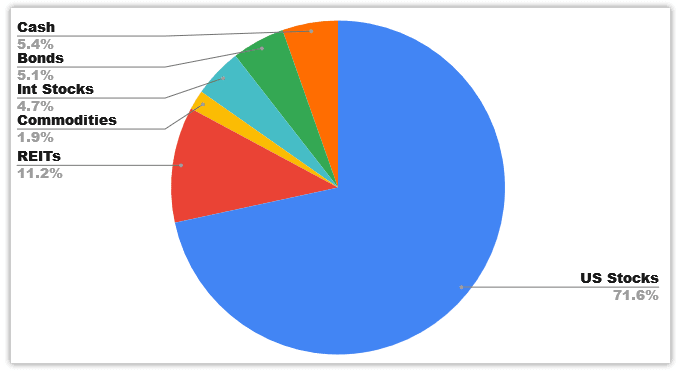
What's a REIT, anyway?
A REIT stands for a real estate investment trust.
Basically, it's an index fund that invests entirely into companies that make their money from real estate.
Here's Vanguard's more official definition from the page of their REIT index fund that I invest in. (It's called the Vanguard Real Estate Index Fund, ticker VGSLX.)
This fund invests in real estate investment trusts—companies that purchase office buildings, hotels, and other real estate property. REITs have often performed differently than stocks and bonds, so this fund may offer some diversification to a portfolio already made up of stocks and bonds."
Let's look at this claim a little more closely.
To do so, we can click the "portfolio" tab of VGSLX. This shows the fund's 10 largest holdings, which include companies like:
- Public Storage – those big orange storage units you see everywhere.
- Prologis – An enormous company that owns "logistics facilities" aka warehouses. When you order that Amazon delivery, if it doesn't come from an Amazon center, there's a good chance it came from a Prologis warehouse.
- American Tower – a real estate company that rents out most of the cell towers in the U.S to the major cell phone companies.
In other words, REITs are a way for Average Joes like me to pretend to be real estate moguls.

Why REITs Pay Big Dividends
Vanguard's description continues:
The fund may distribute dividend income higher than other funds, but it is not without risk. One of the fund's primary risks is its narrow scope, since it invests solely within the real estate industry and may be more volatile than more broadly diversified stock funds."
Let's translate that part about higher dividend income.
REITs were established by law in 1960, and that law has an interesting quirk where, by law, those REITs have to distribute 90% of their taxable income as shareholder dividends.
OBJECTION, your honor!
Except not, because paying out 90% dividends is crazy high, and a cool benefit to shareholders.
For reference, many companies in the S&P 500 don't pay any dividends. Of those who do, the average payout ratio for the past hundred years is somewhere around 50-60% of income.
So in the world of stock investments, REITs paying 90% is definitely high.
Why would a REIT would want to pay so much dividends?
Well for one, it's the law, at least if you want to be a REIT.
But that begs the question… why would any company want to be a REIT, if they're just going to distribute away all their earnings?
One word: taxes.
By law, when a REIT distributes their profits to shareholders, the IRS doesn't tax those profits.
This is awesome for the company. They can go on running their business, mostly tax free, as long as they distribute nearly all of their profits back to their shareholders.
Of course, the government, never one to miss an opportunity for taxes, does eventually collect tax on those profits. They just do so by taxing individuals on the REIT dividends they receive.
Specifically, any REIT dividend income you receive is taxed as ordinary income.
Quick example:
- Say I invest $10,000 in Vanguard's VGSLX.
- At current rates, the REIT should pay me about $250 per year in dividends.
- BUT, those dividends will be taxed at my ordinary tax rate of 24%.
- Run the math, and my $240 dividend check gets whittled down to $190 after the tax man gets his cut.
That's kind of brutal.
Especially when you consider that dividends from all stocks besides REITs are usually taxed at the "qualified dividend rate" which for most people (me included) is just 15%.
But what if…
Avoiding brutal taxes by holding REITs in a tax-advantaged account
The bogleheads talk about something called tax-efficient fund placement.
The idea is that for "tax-inefficient" investments like REITs (and more commonly, bonds) you should hold them in accounts that are protected from taxes.
Usually, this means retirement accounts.
Like, a Roth IRA.
In a Roth IRA, you don't have to pay taxes on your investments' earnings.
So in the case of a REIT, instead of your dividends getting taxed at 24%, they get taxed a big fat 0%.
Sign me up!
But it gets better.
In an efficient stock market, the market should price in the effect of taxes. Meaning that if everyone knows REITs dividends will be subject to high income taxes, then the price of REITs should be less.
This makes sense. Imagine you have the choice between two investments.
- Investment A: Pays you 5% dividends, subject to a 15% tax rate
- Investment B: Pays you 5% interest, but is subject to a 24% tax rate
If you were any kind of rational, you'd pay less for Investment B since you're going to pay twice as much taxes on it.
As all investors come to this decision, the market en-masse makes the tax-inefficient stuff cheaper to invest in.
But if you choose to hold that tax-inefficient stuff (like REITs) in a tax-protected vehicle (like a Roth IRA) you're basically getting the discounted price, without any of the drawbacks!
Why REITs in Roth is the ultimate loophole
What I just explained is true for any tax inefficient investment.
But REITs kick the advantages up a notch.
Why?
Because the REITs, as a company, are barely taxed on their earnings.
Normally, an extremely tax efficient company will be an extremely profitable company, and so the stock price should be higher.
But REITs distribute over 90% of their profit, before any taxes are paid, remember?
In other words, if you hold REITs in a Roth IRA, you are getting paid money that's never been taxed, in an account that will never have to pay taxes.
This might be the only completely tax-free money in the history of time.
How much does this little quirk matter?
Admittedly, not a ton.

But in theory, these little tricks should boost the expected lifetime return of your portfolio. That said, it's also not clear how efficient the market is, especially when we're talking about bizarre layers of taxes.
But in any case, if there's a free lunch available for taking, so I'm gonna grab it!
Final Conclusion – The 3 Reasons I Hold REITs in my Roths
To wrap it up, here's my three biggest reasons for this somewhat unusual investment.
- Diversification – REITs are real estate companies, and I like that this is a different asset than the businesses that dominate the rest of my portfolio.
- Tax Efficiency – By holding a REIT in my Roth, I can lower my tax rate on REIT income from 24% to 0%.
- Potential Market Inefficiency – Due to the weird legal structure of REITs, holding them in your Roth represents a direct, tax-free transfer of company profits unlike anything else I'm aware of in the investment world. In theory, this is a cool benefit, although it's unclear and difficult to measure the real financial advantage of this.
Disclaimer: Nothing in this article is financial advice and is just my nonprofessional opinion. Always do your own research.
Related Articles:
- How to Hack Your Roth IRA as an Emergency Fund (Tax and Penalty Free!)
- The No Stress Solution for Deciding Between a Roth or Traditional IRA
- VTIAX vs. VFWAX: Which Vanguard International Index Fund is Best for You?
How Do I Withdraw Money From My Roth Ira
Source: https://mymoneywizard.com/reits-in-roth-ira-loophole/
Posted by: garnernuir1940.blogspot.com
0 Response to "How Do I Withdraw Money From My Roth Ira"
Post a Comment